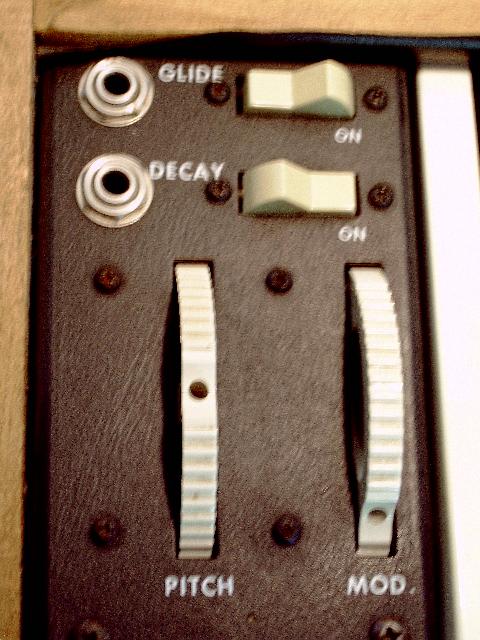
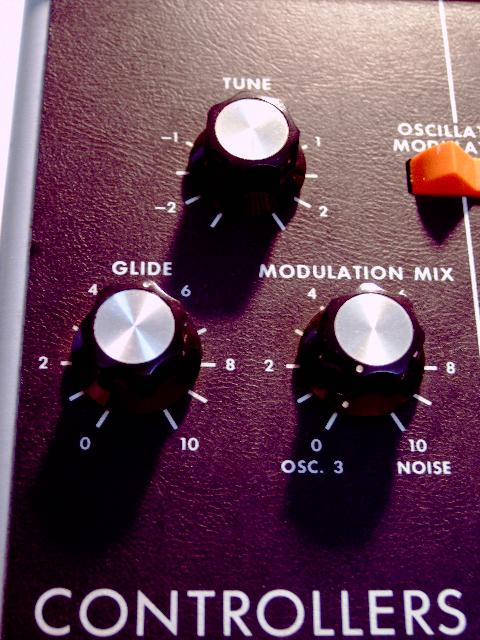
Modifies Controls voltages for
oscillators and filters. There
is a variable portamento, called
"glide" for the pitch control
voltage. Otherwise the cross-mod
and filter control voltage may
be taken from any mix of oscillator
1 and noise.
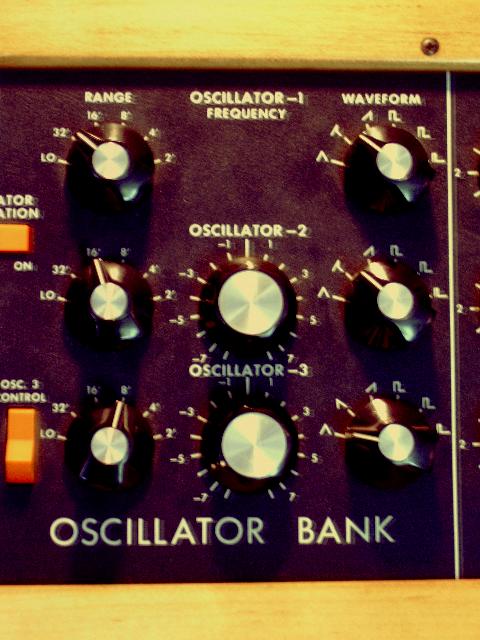
The Oscillator section has
three oscillators, one of which
may send control voltage that
may modulate the two other, or the
filter. This will act as both
LFO and cross-modulation.
There are six octave ranges
and six waveforms for each
oscillator.
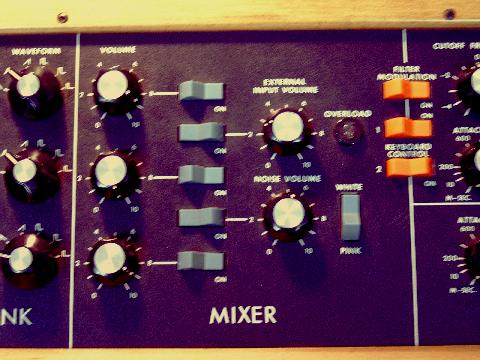
oscillators with further two
input sources: Noise and external
input. This is the chance to apply
the famous Moog filter to any sound.
Mixing the oscillators really is
the source of a large variation
of timbres.
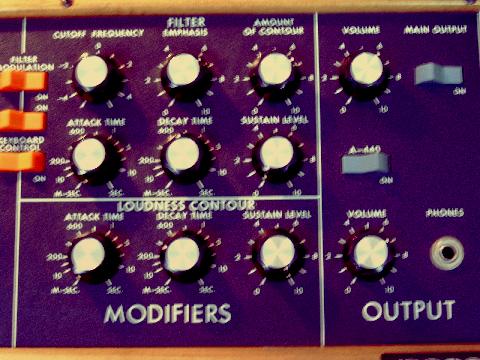
famous moog resonant filter.
Control of cut-off, resonance
and amount of control voltage.
The section also has its own
envelope with attack, decay and
sustain. Release is 0 or the same
as decay, flipping a switch.
The control voltage is mixed
with 0,1/3, 2/3 or 3/3 keyboard
follow, through two switches, or
with the control section voltage
through another switch.
The Loudness section is a voltage
controlled amplifier with its
own ADS(+R) envelope. Again,
decay is release at flipping a
switch
of the control section. The pitch
voltage has its own wheel, and
the control voltage output has
its own wheel. The lower switch
is the beforementioned "release"
switch, while there is another
switch to turn on/off portamento
which on a Moog is called "glide"